“This book has upended my view of high-speed rail. Its analysis of HSR in Spain, the world’s second longest network, reveals why this colossal undertaking failed to alter the dominant mobility paradigm. Along the way, we learn richly from Buier’s observations on capital as an environment making-force.” • Gareth Dale, Brunel University
“Especially unusual and original given the state of orthodox anthropology in the 21st century, the study of space and time that the author makes is ineluctably about class.” • Gavin Smith, University of Toronto
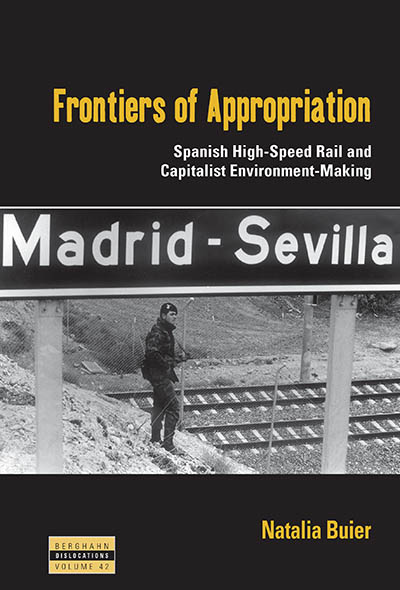
High-speed trains are an icon of the green revolution in transport and mobility. For more than thirty years, AVE (Alta Velocidad Española, or Spanish HSR (High Speed Rail)) has been an instrument for transforming the public railway company, reshaping labor relations and advancing a model of regional development; yet Spain remains a car-dominated society. Frontiers of Appropriation delves into the history of Europe’s most advanced high-speed rail system to assess the transformations it has brought about. The towering yet marginal position of AVE in the Spanish transport market is not a paradox but an expression of the role of HSR in consolidating the hegemonic mobility paradigm.
Natalia Buier is a Ramón y Cajal researcher at the Complutense University of Madrid. She is currently working on a historical ethnography of groundwater depletion in Southwestern Spain. Most recently, she has coedited, with Susana Narotzky and Theodora Vetta, Agricultural Extractivism in the Mediterranean Region: A Socioecological View (Palgrave Macmillan 2026).
BISAC: SOC002010 SOCIAL SCIENCE/Anthropology/Cultural & Social; HIS045000 HISTORY/Europe/Spain; TRA004000 TRANSPORTATION/Railroads/General
available open access under a Creative Commons Attribution-NonCommercial-NoDerivatives 4.0 International License (CC BY-NC-ND 4.0) with support from Berghahn Open Migration and Development Studies initiative.