“Köhler integrates a meticulous analysis of recent developments related to urban migrations and rapidly advancing rural sedentarization in a general description of the relationship between various forms of mobility, social organization, and identity formation among the Wodaabe and thus provides an overall analysis of structural stability and change…[His] work can be recommended to all those who are interested in pastoral nomadism and the societies of the West African Sahel region. It is also an inspiring contribution to recent debates in social science mobility research.” • Journal of the Royal Anthropological Institute
“…a substantial addition to the body of literature that examines ongoing transformations in the lifestyles of contemporary nomadic Fulɓe societies. Its central thesis, which stresses the translocal networking ability of nomadic peoples, sheds valuable light on the adaptive strategies required to cope with increasing global resource scarcity.” • Nomadic Peoples
“A highly welcome contribution to research on mobility in West Africa and more particularly in the West-African Sahel region in as far as it focusses on the complexity of mobility phenomena in a pastoral nomadic group.” • Elisabeth Boesen, Université du Luxembourg
“This is a wonderful and deeply detailed study of a group of Wodaabe in Niger. The author’s descriptions of a sub-group of Gojanko’en and their various strategies of mobility, dispersion, and cohesion is absorbing and clearly based on solid fieldwork.” • Wendy Wilson-Fall, Oeschle Center for Global Education
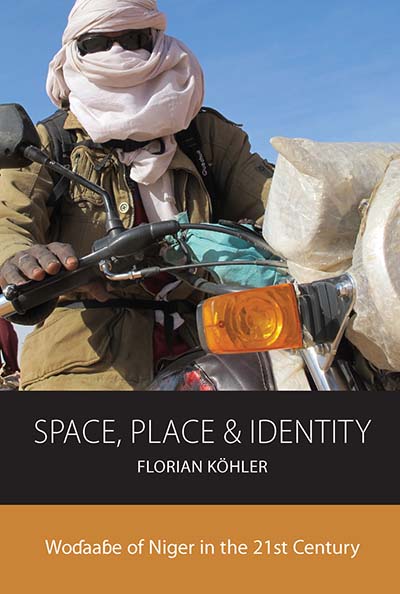
Known as highly mobile cattle nomads, the Wodaabe in Niger are today increasingly engaged in a transformation process towards a more diversified livelihood based primarily on agro-pastoralism and urban work migration. This book examines recent transformations in spatial patterns, notably in the context of urban migration and in processes of sedentarization in rural proto-villages. The book analyses the consequences that the recent change entails for social group formation and collective identification, and how this impacts integration into wider society amid the structures of the modern nation state.
Florian Köhler is currently a research fellow at the Max Planck Institute for Social Anthropology in Halle, Germany. He is also trained as a practitioner in peace-building and conflict-resolution and worked for the German Development Service (DED) in Haiti and for the Civil Peace Service (ZFD) in Niger, Benin and Burkina Faso.
LC: DT547.45.B67 K64 2020
BISAC: SOC015000 SOCIAL SCIENCE/Human Geography; SOC062000 SOCIAL SCIENCE/Indigenous Studies; SOC002010 SOCIAL SCIENCE/Anthropology/Cultural & Social
available open access under a Creative Commons Attribution-NonCommercial-NoDerivatives 4.0 International License (CC BY-NC-ND 4.0) with support from the Max Planck Institute for Social Anthropology.